.png/:/cr=t:0%25,l:1.08%25,w:97.83%25,h:97.83%25/rs=w:370,cg:true,m)
.png/:/rs=w:370,cg:true,m)
.png/:/cr=t:0%25,l:0%25,w:100%25,h:100%25/rs=w:370,cg:true)
.png/:/cr=t:0%25,l:0%25,w:100%25,h:100%25/rs=w:370,cg:true)
CEO & FINANCE
THE FINANCIAL STATEMENT TELLS YOU WHAT HAPPENED. PATHERN™ SHOWS YOU WHERE IT STARTED.
When profit falls, the fastest response is usually to reduce costs, freeze recruitment or remove roles.
Sometimes that is the correct decision. Sometimes it removes productive capability while the condition draining value remains untouched.
PATHERN™ connects people, positions, decision authority and operational dependencies to reveal where value is actually being lost—before leadership commits money to the response.
In the example shown, cutting 20 roles appears to recover the missing €2 million. Structural visibility reveals another possibility: one approval bottleneck is delaying decisions, returning completed work and forcing multiple teams into rework and overtime.
The financial decision is no longer based solely on the visible result. Leadership can determine whether to reduce costs, repair the structure—or do both.
VALIDATE THE PROBLEM. PROTECT PRODUCTIVE CAPABILITY. INVEST WHERE THE LOSS IS ACTUALLY CREATED.
Request pilot access to see what your financial data cannot show.

HR & PEOPLE
STAFF TURNOVER TELLS YOU PEOPLE ARE LEAVING. PATHERN™ SHOWS YOU WHAT THEY MAY BE LEAVING.
When staff turnover rises, the natural response is usually to improve retention: increase salaries, offer bonuses, strengthen benefits, recruit more aggressively or invest in employee engagement.
Sometimes that is exactly the right decision.
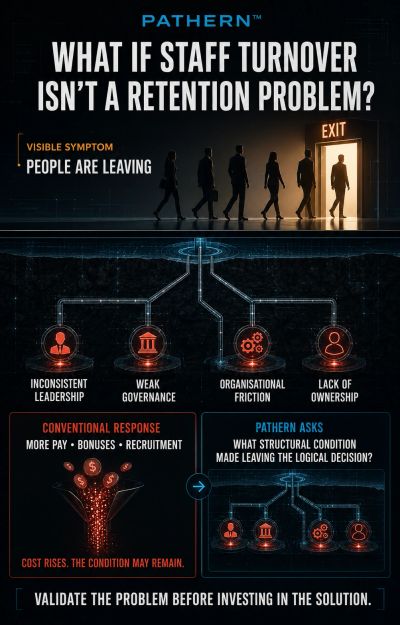
But turnover is an outcome. It does not tell you which organisational condition produced it.
Employees may be responding to inconsistent leadership, weak governance, unclear ownership, decision bottlenecks, organisational friction or limited progression. PATHERN™ does not assume which explanation is correct. It provides structural visibility to identify the conditions actually present before HR investment is committed.
That changes the decision.
If compensation is genuinely driving turnover, increasing pay becomes an evidence-supported investment. If the real condition sits elsewhere, increasing salaries may simply raise payroll while the reason people leave remains untouched.
PATHERN™ helps HR move beyond managing the visible people problem and understand the structure surrounding it.
DON’T JUST ASK HOW TO RETAIN PEOPLE.
ASK WHAT MADE LEAVING THE LOGICAL DECISION.
Request pilot access to see what your HR metrics cannot show.
OPERATIONS
MISSED DEADLINES TELL YOU WORK IS SLOW. PATHERN™ SHOWS YOU WHERE THE FLOW IS BEING STOPPED.
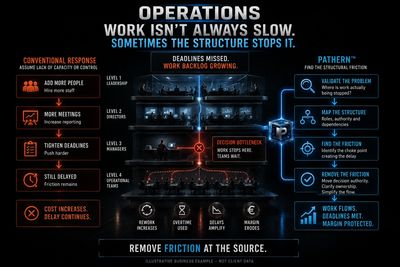
When deadlines are repeatedly missed, the natural response is usually to increase operational capacity: hire more people, add project management, increase reporting, tighten deadlines or introduce more oversight.
Sometimes that is exactly the right decision.
But slow delivery does not automatically mean the organisation lacks capacity.
PATHERN™ maps people, positions, decision authority and operational dependencies to identify where work is actually being restricted.
In this illustrative example, capable operational teams are completing work at Level 4, but routine decisions repeatedly stall at Level 3. Teams wait for approval, priorities change, completed work is reopened and overtime is then used to recover the delay.
The organisation may not need more people.
It may have existing capacity trapped behind a structural bottleneck.
Once that condition is visible, leadership can move decision authority, clarify ownership, simplify approvals or strengthen the position creating the constraint.
If PATHERN™ confirms that additional capacity is genuinely required, hiring remains the correct decision. The difference is that the investment is now supported by structural evidence rather than assumed from the symptom.
DON’T JUST ADD CAPACITY TO A SLOW SYSTEM.
FIND WHAT IS STOPPING THE CAPACITY YOU ALREADY HAVE.
Request pilot access to see where work is actually being stopped.
RISK & GOVERNANCE
MANAGING RISK PROTECTS THE BUSINESS. PATHERN™ HELPS ENSURE YOU ARE PREVENTING THE RIGHT RISK AT ITS
When a significant business risk becomes visible, organisations naturally respond with controls, policies, monitoring, mitigation programmes and additional resources.
Those actions may be entirely correct.
But every prevention strategy depends on one critical assumption: that the organisation has correctly identified what is actually creating the risk.
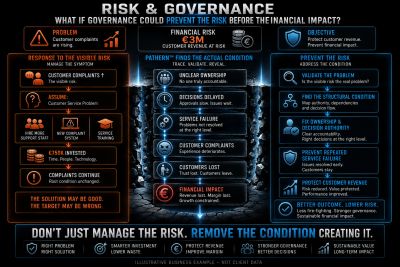
Consider an illustrative example where customer complaints are increasing and €3 million of customer revenue is potentially exposed. The obvious response may be to strengthen customer service—hire additional support staff, introduce new systems and invest in training.
But what if customer service is not the underlying problem?
PATHERN™ examines the structure behind the visible risk. It may reveal unclear ownership, delayed decisions and weak decision authority preventing service teams from resolving customer problems. Customer complaints are then the downstream result of a structural condition occurring elsewhere.
That changes the governance decision.
Instead of investing only in managing complaints, leadership can address the condition creating them—while still strengthening customer service where the evidence supports it.
The objective is not to replace existing governance or risk frameworks. It is to give them a stronger starting point: validate the problem before committing resources to its prevention. That is consistent with the PATHERN framework's central sequence of observation → validation → structural condition → intervention → investment.
DON’T JUST MANAGE THE RISK. REMOVE THE CONDITION CREATING IT.
Request pilot access to see what may be creating risk inside your organisation.
AI GOVERNANCE
AI GOVERNANCE CAN ONLY GOVERN WHAT IT CAN SEE.
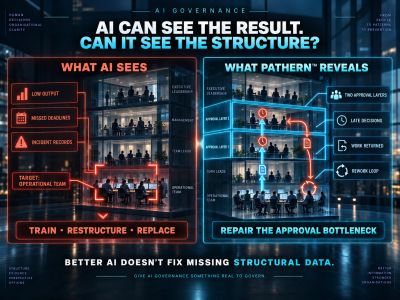
An AI system sees low output, missed deadlines, incident records and a static organisational chart. Based on that evidence, it flags the operational team and recommends training, restructuring or replacement.
The recommendation may be logically consistent—and still target the wrong people.
What if routine decisions must pass through two management levels? Approvals arrive late, completed work is returned and the team repeatedly loses capacity through delay and rework. If those structural relationships are missing from the data, AI sees the poor result but not the condition producing it.
PATHERN™ provides the missing organisational context: people, positions, decision authority, dependencies and accountability, connected within a structured, tagged and machine-readable representation.
In the example shown, structural visibility changes the decision. Instead of penalising the team producing the visible result, leadership can repair the approval bottleneck above it.
PATHERN™ does not replace existing AI controls. It gives AI governance something those controls cannot create by themselves: visibility of how the organisation actually functions.
BETTER AI DOESN’T FIX MISSING STRUCTURAL DATA. GIVE AI GOVERNANCE SOMETHING REAL TO GOVERN.
DIAGNOSTICs
PATHERN™ DOESN’T GIVE YOU ANOTHER SCORE. IT SHOWS YOU WHAT THE SCORE CANNOT LOCATE.
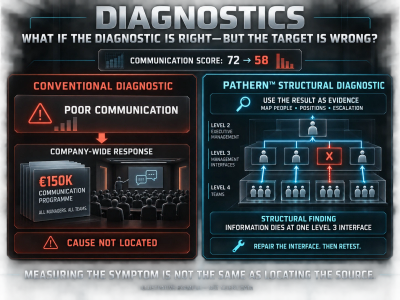
Consider an illustrative 300-person organisation whose communication score falls from 72 to 58. The diagnostic has identified a genuine problem, so leadership prepares to invest €150,000 in company-wide communication training.
But the score does not establish where communication is breaking.
PATHERN™ uses the diagnostic result as evidence, then connects the affected people, positions, management layers and escalation paths. In the example shown, three organisational routes function correctly. Information consistently disappears at one Level 3 management interface before reaching executive leadership.
The company-wide programme could therefore train hundreds of people who are already communicating correctly while leaving the failed interface untouched.
PATHERN™ does not dismiss conventional diagnostics. They can be highly effective at measuring perceptions, outcomes and behavioural signals. PATHERN™ adds structural placement, propagation and traceability so leadership can determine what the result means inside the organisation.
If the problem is genuinely widespread, the broader investment is validated. If it originates at one structural point, leadership can repair that point and retest before committing further resources.
USE THE DIAGNOSTIC. LOCATE THE SOURCE. FUND THE RIGHT INTERVENTION.